In a world drowning in data, how do we store and transmit information more efficiently? The answer lies in Huffman Coding — a beautifully simple yet powerful algorithm used for lossless data compression. It’s been a cornerstone since it was introduced.
What Is Huffman Coding?#
Huffman Coding is a greedy algorithm used to compress data without losing any information. The idea is simple:
Assign shorter codes to more frequent characters and longer codes to less frequent ones.
Ever tried zipping a file to save space? That magic trick behind the scenes? That’s compression — and Huffman Coding is one of the smartest ways to pull it off.
It’s like using nicknames. Instead of saying “Jonathanathan” every time, you just say “Jon”. Saves time. Saves space. No information lost. That’s the Huffman vibe.
It uses a binary tree structure to build optimal prefix codes (no code is a prefix of another), ensuring efficient encoding and decoding.
Terminologies#
| Term | What It Means |
|---|---|
| Character Frequency | How many times a character appers in the text. |
| Leaf Node | A tree piece that holds a character. It has no children. |
| Internal Node | A tree piece that connects other nodes. It doesn’t hold a character. |
| Root Node | The top part of the tree that connects everything. |
| Min Heap | A list that always gives the smallest number first. |
| Binary Code Assignment | Left turn = 0, right turn = 1. Used to make codes from the tree. |
| Prefix-Free Code | No code starts the same as another, so there’s no confusion when reading. |
| Compression | Making data smaller so it takes up less space. |
How It Works (Step-by-Step)#
Calculate Frequencies
Count how many times each character appears in the input data.Build a Priority Queue
Each character becomes a leaf node with its frequency as weight.Build the Huffman Tree
Repeatedly:- Take two lowest-frequency nodes,
- Combine them into a new node with the sum of their frequencies,
- Insert the new node back into the queue. Continue until only one node (the root) is left.
Assign Binary Codes
Traverse the tree:- Go left ➡️ append
0 - Go right ➡️ append
1
- Go left ➡️ append
Example#
Let’s take a simple string:
"beep boop beer"We’ll walk through how Huffman compresses this.
Step 1: Frequency Count#
We start by counting the frequency of each character in the string “beep boop beer”:
b: 3e: 4o: 2p: 2r: 1- (space): 2
These frequencies help us decide which characters should get short or long codes.
Step 2: Build a Min Heap#
Next, we create a Min Heap (priority queue) from the characters and their frequencies:
[ r:1, o:2, p:2, (space):2, b:3, e:4 ]
We repeatedly take out the two lowest frequency nodes, combine them, and put the result back into the heap. This process eventually forms our Huffman Tree.
Step 3: Create the Huffman Tree#
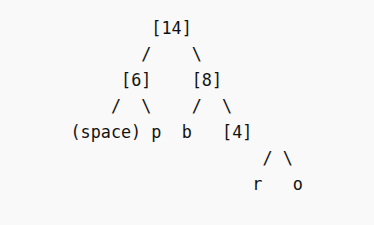
Keep merging the two smallest nodes until only one node (the root) remains. Let’s say we get this structure:
Step 4: Assign Binary Codes#
Now, we traverse the tree and assign binary codes. The rule is:
- Left =
0 - Right =
1
From the tree, we get the following codes:
e → 10b → 11(space) → 000p → 001r → 1000o → 1001
(Note: The exact codes may vary depending on how the tree was built, but they will always be prefix-free.)
Step 5: Encode the Original String#
Let’s encode the original string “beep boop beer” using the Huffman codes:
Original:
b e e p b o o p b e e r
Using the codes:
b → 11
e → 10
p → 001
(space) → 000
o → 1001
r → 1000
So, we get the following binary string: 11 10 10 001 11 1001 1001 001 11 10 10 1000
Final Binary String:#
111010001111001100100010010110101000
This is much smaller than using 8-bit ASCII per character.
Where Is Huffman Coding Used?#
Huffman coding is used extensively in:
- File Compression: Formats like
.zip,.gz - Image Compression: JPEG (in entropy encoding stage)
- Video Compression: MPEG, H.264 codecs
- Text Compression: Unix
compress, PDF text compression - Data transmission: When minimizing bandwidth is critical
Advantages#
Lossless Compression — No data is lost during encoding.
Optimal for symbol-by-symbol encoding — Based on frequency.
Fast and Simple — Efficient in both compression and decompression.
Prefix-free codes — No ambiguity during decoding.
Disadvantages#
Requires Frequency Table — Needs to be stored/sent along with compressed data.
Not Always Best — For small data sets or near-uniform frequencies, it might not compress well.
Static — Doesn’t adapt to changing data unless used in a dynamic/adaptive version.
Tree Overhead — Storing the tree adds some overhead for very small inputs.
When Not to Use Huffman Coding#
- If you’re compressing already compressed files (like
.mp4,.png) - When your data has very little redundancy
- If you’re aiming for real-time compression with fast, adaptive techniques (like Arithmetic or LZ-based compression)
Conclusion#
Huffman Coding remains one of the most elegant examples of how theory meets practicality. It teaches us the value of frequency, greedy algorithms, and efficient data structures — all wrapped in a sweet little binary tree.
Whether you’re building your own compression tool, diving into how JPEG works, or just brushing up for a comp-sci interview, Huffman Coding is a must-know classic.
“The art of programming is the art of organizing complexity.” — Edsger Dijkstra