A* Algorithm Made Easy#
When we want a computer, robot, or game character to move from one place to another, the biggest challenge is: how to find the shortest and best path?
The A* (A-Star) algorithm helps us do exactly that, in a smart and efficient way.
What is A* (A-Star)?#
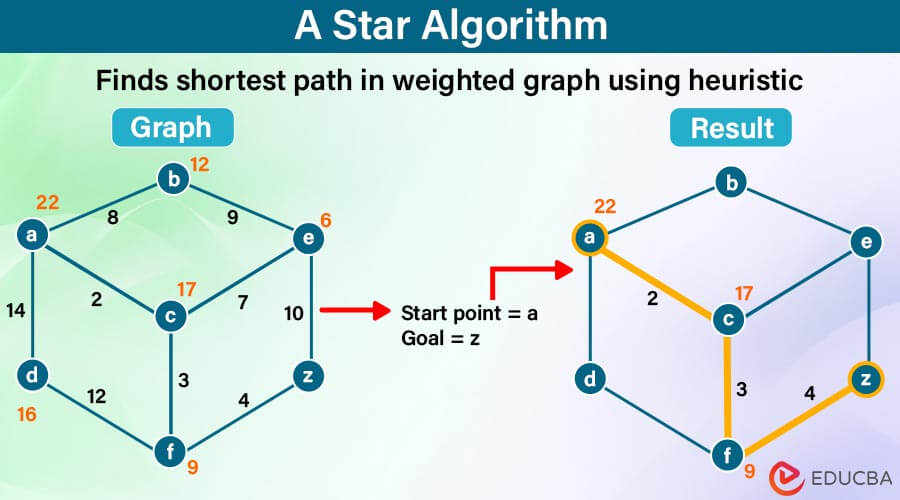
The A* algorithm is a popular and efficient pathfinding and graph traversal algorithm used to find the shortest path between a start node and a goal node. It combines the benefits of Dijkstra’s algorithm and heuristics to efficiently navigate paths by considering both the cost to reach a node and an estimated cost from that node to the goal.
Key Definitions for A* Algorithm#
1. g(n) – Actual Cost#
The cost (or distance) from the start node to the current node. It keeps track of how far we’ve actually travelled in the path so far.
2. h(n) – Heuristic Cost#
The estimated cost from the current node to the goal node. It’s like a “smart guess” — helps the algorithm predict which direction looks promising.
3. f(n) – Total Estimated Cost#
The combination of both actual and estimated cost:
f(n) = g(n) + h(n)
It represents the total cost if we were to take that path, so the node with the lowest f(n) is usually explored first.
4. Open List#
A collection of nodes that are yet to be explored but are known and reachable. Think of it as a “to-do list” for the algorithm.
5. Closed List#
A collection of nodes that the algorithm has already visited and processed. Once a node moves here, it’s not revisited again.
6. Start Node#
The node from where the search begins. Its g(n) = 0 because it costs nothing to reach itself.
7. Target (Goal) Node#
The destination node we’re trying to reach using the shortest (or least costly) path.
8. Heuristic Function (h)#
The heuristic function h is critical; it must underestimate the actual cost to ensure optimality. A function that estimates the cost to reach the goal, commonly calculated using distance metrics like Manhattan distance or Euclidean distance, depending on the grid or graph.
How A* Algorithm Works#
The algorithm maintains two sets:#
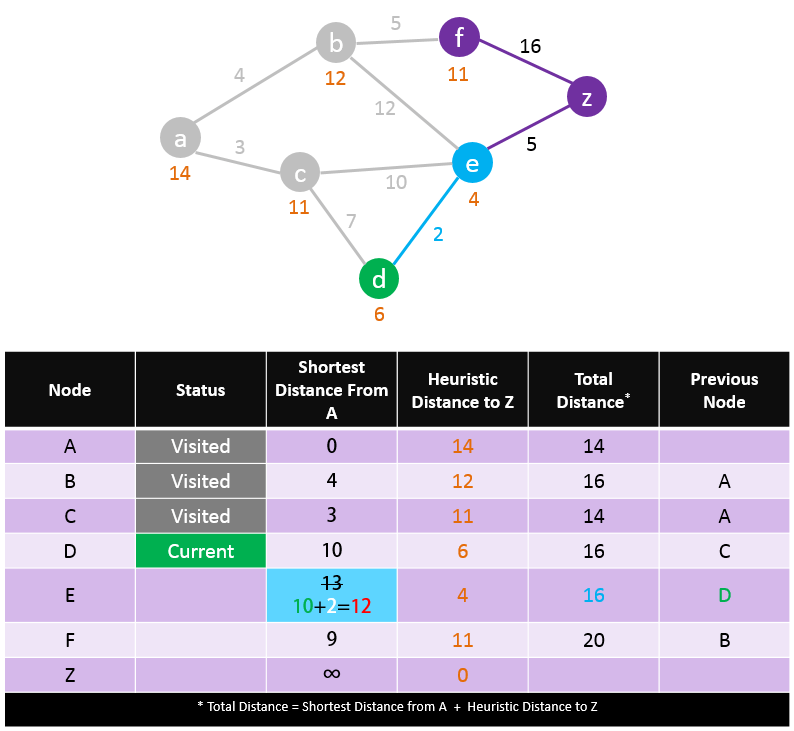
An open set (priority queue) of nodes to be evaluated, prioritized by the lowest f-value,
A closed set of nodes already evaluated.
Steps:#
Initialize the open list with the start node.
Select the node from the open list with the lowest f.
If it is the goal, reconstruct the path.
Otherwise, move it to the closed set and evaluate its neighbors.
Calculate tentative g scores for neighbors.
If a better path is found (lower g), update the neighbor’s g, h, and f scores, and record its parent.
Repeat until the goal is reached or no path exists.
Applications of A* Algorithm#
Navigation systems for shortest path routing.
Game AI for pathfinding in virtual worlds.
Protein Folding and Bioinformatics
Automated Theorem Proving
Network routing protocols.
Puzzle Solving (AI Games)
Robotics Navigation in Dynamic Environments
3D Animation and Cinematography
Natural Language Processing
Where A* Stumbles (Yes, Even Smart Algorithms Have Bad Days)#
Even smart algorithms have weak spots and A* is no exception.
1. Inaccurate Heuristic:#
If the heuristic misleads (overestimates), A* loses its sense of direction and may miss the optimal path.
2. Large Graphs:#
In huge maps, A* stores too many nodes, memory and time blow up fast.
3. Dynamic Environments:#
When the map keeps changing, A* can’t adapt, it must start over.
4. Bad Heuristic Design:#
If the heuristic isn’t admissible (never overestimates), A* can’t guarantee the best path.
5. Real-Time Limits:#
A* thinks a bit too much for live systems, slower when quick decisions matter.
Summary#
What sets A* apart from other algorithms is that it combines features of Dijkstra’s algorithm and Greedy Best-First Search by using a heuristic to estimate the cost to the goal. This balance of actual traveled cost (g-cost) and heuristic cost (h-cost) allows A* to explore fewer paths, making it both efficient and guaranteed to find the shortest path if the heuristic is admissible and consistent. Unlike uninformed search algorithms, A* uses problem-specific knowledge for faster solutions. Unlike purely greedy algorithms, it ensures optimality.